The contradiction of freedom
What does it mean to be free in a society where fear hinders –or rather dictates– one’s existence?
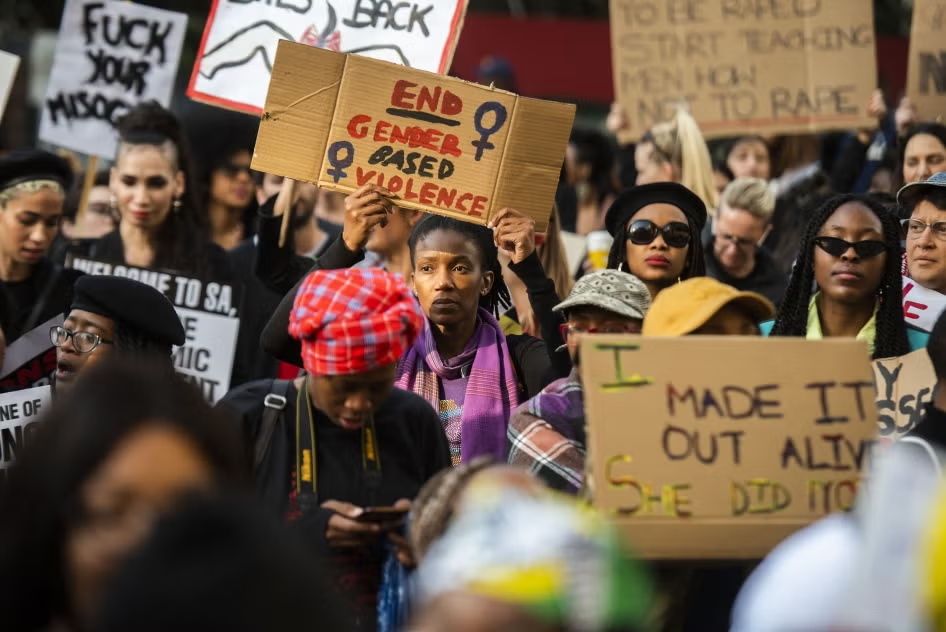
The Constitution of the Republic of South Africa1, 1996, chapter 2, sections 9, 10 and 12 promise equality, protection, and freedom in dignity. Yet for many women this doesn’t seem fit to be the case. And for twelve women last summer, it definitely wasn’t.
You might’ve heard of the tragedy between July and September, you might’ve seen the headlines about twelve women violently killed in Johannesburg2, and you might have heard all the questions wondering whether these cases were all committed by the same perpetrator. While this displays a barbarous nature for potential suspects, what does this speak of the country in which it took place? Is this really an act of poor individual decision-making, or the result of a society that fails to protect its victims? And can a country really claim to oppose injustice when it has become so accustomed to it?
Apartheid’s Unequal Legacy
South Africa has endured the brutal political structure of apartheid from 1948 to 1994, creating the roots for racial segregation and laying the foundation for deeply embedded social discrimination. Within this oppressive system, women of colour were left to face triple discrimination based on race, economic status and gender. While apartheid has been proclaimed over, we still see this apartness and persistence of inequalities reflected in modern gender-based violence. Now, I’m not saying that apartheid isn’t over, but I plead you to question what this case shows about the country’s society.
Beyond Promises: the Failure of Protection
Through the Human Sciences Research Council’s study of South African National Gender Based Violence3, we are shown that 35.5% of women in South Africa have experienced physical and/or sexual violence in their lifetime, which translates to 7,847,438 individual women. And if these statistics aren’t shocking or urgent enough for you, I’ll restate what I mentioned at the beginning of this article: twelve women were killed between July and September. Twelve women murdered in the space of two months. And those are only the ones we were told of.
What has anyone in power actually done about it? Well let’s see: President Cyril Ramaphosa has stated that “every municipality must begin a women’s safety audit”, that “high risk areas must be identified”, that audits must “identify broken streetlights, overgrown public spaces, unsafe transport routes and facilities, poorly secured parks, and other conditions that place women at risk”. And finally, he stated that this violence “begins in attitudes that regard women as inferior… with the belief that a man has the right to control a woman”4.
He has presented the initiatives that are to take place and he has criticised the mindset that marginalises women, but he never fully attempted to counteract and put an end to what is the sole root of the problem: the patriarchal ideals that are contemporarily adopted. And simply mentioning it like it’s some sort of anecdote will not do.
The Illusion of Freedom
Why is gender-based violence so persistent in South Africa? To understand this, one must question the system in which it takes place. As president Ramaphosa said, these violent actions begin with a mindset that entitles men to exercise authority over women. And while the president seems to deter this, South Africa has still had a history of disproportionate
distribution of economic, and social power, where women are left defenseless. This being the case, it becomes necessary to inquire into these norms, since they can reinforce the very idea that males stand on a pedestal above females. This then leads to forcing women to bear the responsibility of protecting themselves. To do so, they then alter their lives with caution to avoid potential physical and sexual violence.
The South African constitution promises the right to freedom for everyone. It states “Everyone has the right to freedom and security of the person, which include the right not to be deprived of freedom arbitrarily or without just cause”5. This promise has been made but it has not been kept. Can someone really be free if their every deed is limited with safety measures? Typical daily actions such as going on walks or runs have been restricted in the fear of being harassed or, in this case, killed. So should fear count as a “just cause” for the deprivation of freedom? And has this constitutional right really been granted to women? No.
A Collective Responsibility
Beyond the responsibilities of the nation, if we look into the African philosophy of Ubuntu6, we are all responsible for one another’s actions. The philosophy bases itself around our interconnectedness and relationships with each other. It definitely doesn’t lift the personal prosecution, but it addresses violence against women as a community’s issue rather than simply just an individual one. This philosophy encourages us to think along the lines of “I am because you are; and you are because I am”, and to question what our community tolerates and if it should continue in doing so. “A person is a person through others”, so if we continue to tolerate these matters or treat them as inconveniences rather than national crises, we start to become as culpable as the offender.
So, are women really free?
According to the Oxford dictionary, the definition of freedom is “the state of being able to act without hindrance”7. So, are women really free in South Africa right now? If their autonomy is restricted by precautions rooted from fear, then they don’t have a vast amount of liberty; they don’t have any liberty at all. Women, as much as men, should have the liberty to live their life without any threats, and this is not the case in South Africa –or most countries for that matter– at present. So no, women are not really free in South Africa right now, and haven’t really been free for the past 78 years.
A Crisis We Cannot Afford to Forget
When I mentioned to my brother that I was writing an article on this topic, he said it wouldn’t be engaging or interesting enough as it’s become “outdated”; why talk about apartheid if it ended in 1994? Why talk about these murdered women if it happened a whole two months ago? He thought I should’ve rather written about the riots in Paris, because it was a more raw and recent subject than this. But then again, that just made me want to write about this topic even more. Inequality does not have an expiry date, and if we forget or disregard a national crisis after simply two months, what does this say of us and our community?
From Privilege to Responsibility
Now, I am privileged enough to be part of the 68% of females8 to have not experienced anything of such measures. And although this should be a standard rather than a privilege, I still hold the responsibility to disseminate and bring attention to this topic. So if you feel in some way similar, spare five minutes of your time to fill in this form by November 28th, and urge for government action towards this matter.
Sources:
- https://www.gov.za/documents/constitution/chapter-2-bill-rights
- https://www.sabcnews.com/sabcnews/ekurhuleni-communities-to-march-against-gbvf-after-12-women-killed/ https://www.bbc.com/news/articles/c6m27dprvzv7o
- https://hsrc.ac.za/media-pack-first-south-african-national-gender-based-violence-study-2022/
- https://www.bbc.com/pidgin/articles/cmwyz9nr1w2po https://www.gov.za/news/speeches/president-cyril-ramaphosa-address-killing-women-ekurhuleni-and-national-gbvf-response
- https://www.gov.za/documents/constitution/chapter-2-bill-rights
- https://journals.sagepub.com/doi/10.1177/14680173241312749 https://www.lionsroar.com/ubuntu-i-am-because-we-are/
- https://www.oed.com/dictionary/freedom_n?tab=meaning_and_use&tl=true#3673716
- https://www.who.int/news/item/19-11-2025-lifetime-toll–840-million-women-faced-partner-or-sexual-violence